
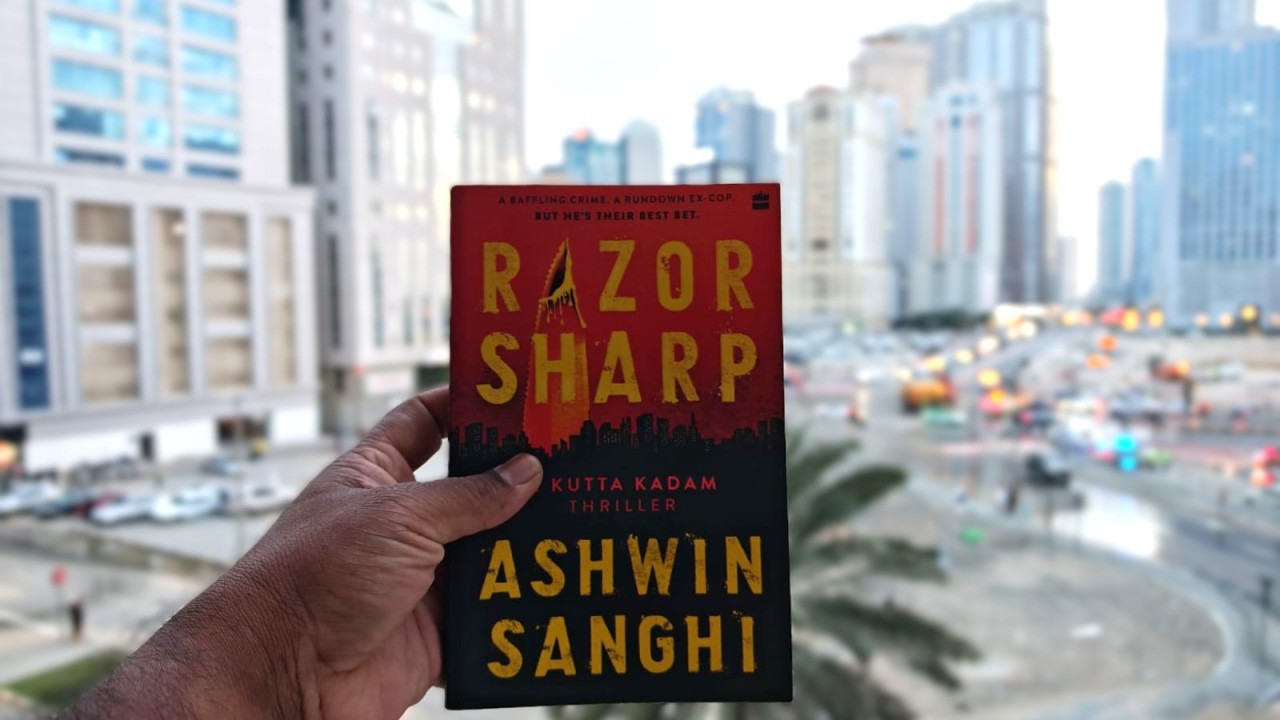
Ashwin Sanghi’s Kutta Kadam thriller is a breathless, brawling page-turner — if you can stomach its rough edges
Razor Sharp is a propulsive, profanity-laced Mumbai crime thriller that reads like a homicide detective’s fever dream and a corrupt politician’s guilty conscience. It’s also Ashwin Sanghi at his most stripped-back, swapping historical mythology for back-alley menace and proving that India’s highest-selling English fiction author can write a grubby, ground-level whodunit just as comfortably as a sweeping civilisational epic.
The nightmare starts with a body
The killings begin not in a Dharavi chawl but in the city’s shadows, in the most deliberate way possible: a victim, a signature mark, and zero apparent logic. When the second body surfaces with the same calling card, Mumbai Police know they have a serial killer — and know, just as quickly, that they’re nowhere near catching him.
Enter Special Commissioner Rane, who does what cornered men in powerful positions always do: he calls in a favour. His old friend Prakash “Kutta” Kadam — suspended from the force, subsisting on online poker, cigarettes, and secrets he won’t share even with his psychiatrist — is pulled unofficially into a case the department can’t solve officially. Meanwhile, Kadam’s daughter Ketul, a sharp-edged lawyer, begins pulling on a human trafficking thread that unravels connections to some very prominent, very dangerous people.
Mumbai doesn’t stay still for a moment. Neither does the book.
A broken man, not a single hero
Sanghi resists the temptation of the infallible detective. Kadam is grey, damaged, and specific in his damage — not the decorative brokenness of a TV crime procedural, but a man crushed under guilt whose precise shape the reader is denied for most of the novel. He hides his drinking from his daughter. He’s rude to his psychiatrist. He smells crime the way a dog smells blood — hence the nickname — but he cannot save himself from his own worst habits.
This “kutta” at the centre of the story is flanked by a cast painted in equally murky shades: cops who bend to political pressure, a cult leader operating under three religious identities simultaneously, mafia fingers in institutional pies, and a city that has normalised every variety of moral compromise. Nobody here is cleanly heroic or cleanly villainous, and that is precisely what makes them feel alive.
How Razor Sharp uses its ensemble
Sanghi leans into a multi-threaded structure, cutting between Kadam’s murder investigation, Ketul’s trafficking case, departmental power games, and the growing menace of a religious cult called Momuma — an acronym for a preacher who presents himself as Hindu Mohan, Muslim Mustafa, and Christian Matthew to different flocks. The parallel storylines give the city a thick, corrupt texture rather than a simple body count. Because the canvas stretches from police lock-ups to Parliament corridors, the rot feels systemic rather than incidental, and every institutional failure lands harder for it.
Crime, chaos, and the horror of competence
One of the book’s quiet strengths is how seriously it takes the machinery of the Mumbai Police. Sanghi has done his reading: departmental hierarchy, the informal rules of the force, the particular way political proximity warps police decisions. The jargon is kept lean; you’re never lost in procedure, but you’re never allowed to forget that real people in real offices — tired, self-interested, occasionally brave — are the only thing standing between the city and worse.
The horror, often, is bureaucratic rather than visceral: a case going cold because careers are at stake, a killer hiding in plain sight because nobody wants to look, and the dawning recognition that Mumbai’s institutions are only as good as the individuals propping them up on any given day. If you’ve ever watched a news cycle in which powerful men walk free and exhausted cops take the fall, the novel hits with an uncomfortable familiarity.
Pacy, punchy, and occasionally too crowded
As a thriller, Razor Sharp is ruthless about momentum. Sanghi writes short chapters with the discipline of someone who knows exactly how long your attention span is at midnight. The book moves like the city it’s set in — loud, relentless, unwilling to pause for you to catch your breath. Readers have reported finishing it in a single sitting, which is both the highest compliment a thriller can receive and a statement about how little sleep it will cost you.
The trade-off is occasional chaos. There are too many characters arriving too quickly, too many subplots threading into each other before you’ve properly oriented yourself in any one of them. The Marathi dialogue adds authentic flavour but is left untranslated, which will disorient readers outside Maharashtra. And when the climax arrives — when the killer’s identity and motive are finally laid bare — some readers will feel the revelation is thinner than the build-up deserved. You’ve been promised a reckoning and get a resolution; satisfying in its bones, but not quite as shattering as the 300 pages that precede it.
So, should you read it?
If you like your crime fiction fast, grimy, and unapologetically Indian, Razor Sharp is absolutely worth your time. It gives you the pleasures of a Mumbai underworld thriller, but roots them in institutions, politics, and a city that feels distressingly plausible.
Come for the murders and the maverick detective; stay for the uncomfortable questions about who really runs Mumbai, who gets protected and who gets sacrificed, and what it costs a man to know the difference between justice and the law. And don’t be surprised if you find yourself watching your local neta (politician) — or your building’s beat cop — with slightly narrower eyes when you’re done.
Rating: ★★★½ / 5
Razor Sharp (A Kutta Kadam Thriller) by Ashwin Sanghi | HarperCollins India, 2024
